
Stationary spot and press welding machines

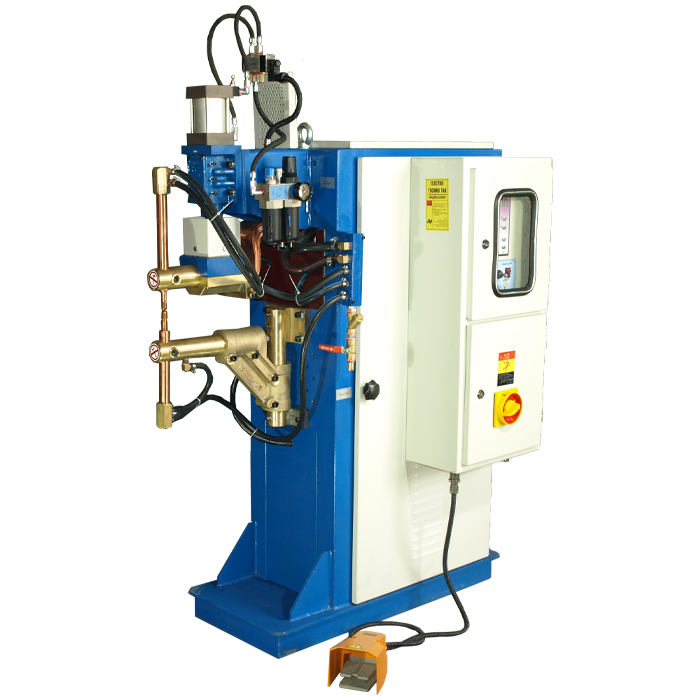

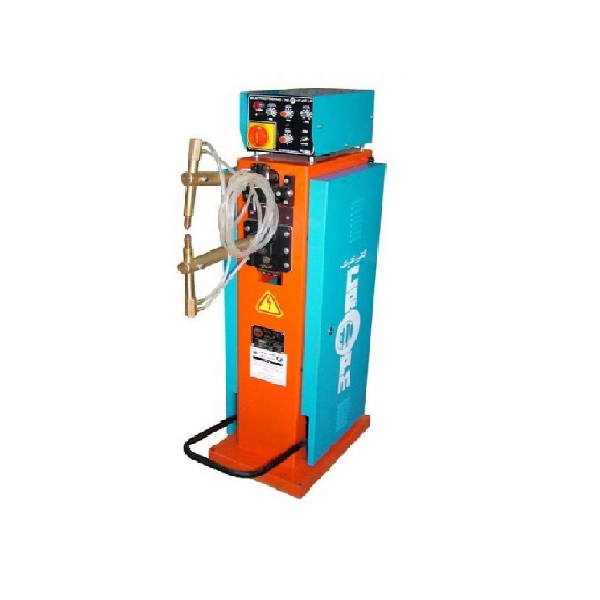
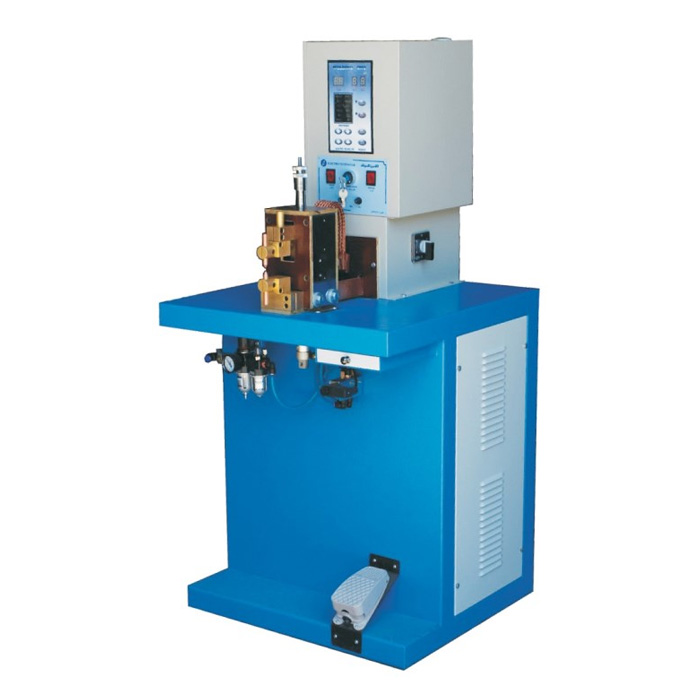


Stationary spot welding machine
Stationary spot welding is a family of resistance welding techniques. In this welding technique, the weld joint in a workpiece is formed by generating heat and passing a high current for a short time, which welds the parts together at different points. The weld zone is the surface on which the electrode is located and through which the current under pressure passes. In general, the electrical contact resistance of the metal between the electrodes includes the contact resistance of the electrodes with the workpiece, between the two workpieces, and the electrical resistance of the workpiece. When the welding current is established, first the microscopically prominent points on the surfaces of the two workpieces are heated due to the concentration of the current, and then the material adjacent to these points. The spot welding electrodes are made of copper alloys that have high thermal conductivity.
Features of Electrotechnotech Stationary Spot Welding Machine
- Optimized and economical design based on high speed and efficiency
- Continuous operation
- Ability to maneuver arms and holders in different directions
- Small and light
- Suitable for mass production
Options
- Possibility of installing a pneumatic movement system (including air jack, solenoid valve and air monitoring unit)
- Possibility of installing speed control and all necessary hoses and connections.
- Analog or digital welding controller timer.
- Accessories include heat sink, thyristor and power switch.
- Long arms up to 1 meter long, water-cooled.
- Possibility of designing and manufacturing shaped and special holders and electrodes for various parts.

Standard components and accessories of the station spot welding machine
- With a fully mechanical base
- With a transformer
- With an industrial body and arms
- With a holder and electrodes
- With a time switch and a spring pressure movement system
- Various service and manufacturing industries
- Wire industries
- Cabinet making
- Kitchen appliances
- Air conditioner ducting and spirals
- Lampshade and lighting industries
Additional descriptions
- This model of station spot welding machine, also known as pedal or sinusoidal spot welding machines, is usually not used in the production of parts that need to pass standard resistance welding safety tests.
- The transformer calculations of these machines are based on air cooling and are fully responsive for continuous operation.
- To maintain the efficiency of the machine, the arm, iron, and electrodes have a circulating water circuit.
- All models of this family of products can be operated with 2-phase 380 V electricity and a minimum current of 25 A.
Stationary welding press machine
How does a stationary welding press work?
The welding press machine welds the workpieces at several points simultaneously, with the difference that these points are determined by pre-defined protrusions (necks). These necks are usually created in one of the parts and the electric current is conducted through these protrusions, ultimately leading to their melting on the second part. This method is used for welding metal sheets and parts, and the average thickness of the sheets welded with this method is between 0.5 and 3 mm. Spot welding press can be easily used for parts made of iron sheets, such as car bodies, car parts, electrical panels, household appliances, fire boxes, military industries, etc. Also, aluminum alloys can be welded with this method, but the higher the electrical and thermal conductivity, the higher the current intensity required for welding them. Ultimately, this requires the use of special spot welding press machines with the ability to create direct current and use different pressures simultaneously.

Introduction to the spot welding process
It is a resistance welding technique in which parts are welded together at different points. The welding area is the surface on which the electrode is located, through which current passes and is under pressure.
The electrical contact resistance of the metal sandwiched between the electrodes is the sum of the following resistances:
1 – Contact resistance of electrodes with the workpiece
2 – Contact resistance between two workpieces
3 – Electrical resistance of the workpiece
Spot welding electrodes are made of copper alloys that have high thermal conductivity and acceptable hardness. In practice, there are various techniques for spot welding, which differ mainly in how the current is connected to the workpiece. Most often, the current is applied to the workpiece by electrodes from two sides, as shown in Figure A-(2-1). Sometimes one of the electrodes is used as a flat horizontal plate. Figure B-(2-1). Sometimes, the number of points to be welded on a workpiece is more than one, so the transformer poles are connected to the bottom plate and the other to all electrodes (1-2)-c.
Electrotechnotech’s spot and press welding machines include the following categories
- Stationary spot welding (S series and ES series): These devices are designed for spot welding in stationary and industrial environments and are typically used to produce high-quality, high-precision parts.
- Stationary welding press (HDS series and SP series): These devices are suitable for pressing metal parts in a stationary and fixed manner and are capable of performing high-pressure resistance welding.
- Spot welding straightening: These devices are specifically designed for straightening and repairing car bodies and metal parts.
- Desktop spot welder: These devices are suitable for working in smaller spaces and for performing spot welds in small workshops or even laboratory applications.
- Mobile welding spot: Portable devices for welding in different locations, suitable for use in mobile work and repair conditions.
- Inverter spot welding: These types of devices are designed using inverter technology for spot welding with low energy consumption and better performance.
- Seam welding: Special machines for welding various seams in metal parts, usually used to produce products that require longitudinal welding.
- Special fixture machine: These devices are designed to perform welding using special fixtures that ensure accuracy and quality of welding in various parts.
‘
Advantages and reasons for choosing Electrotechnotech Industrial Complex
- 46 years of experience in research, design and manufacturing in the field of resistance welding machines
- Creating reliable, high-quality welds
- Tensile, torsional and bending welds
- Low cost of welding and no need to use auxiliary materials
- No distortion on the workpiece and heat affected zone
- Easy operation with semi-skilled operator
- Lightweight, portable and durable
- Service and support for all products for 10 years
- Warranty for 1 year
What is the difference between stationary spot welding machines and stationary welding presses?
Are Electrotechnotech welding machines suitable for mass production?
Can mobile welding machines be used in different locations?


